Bored Pile Contractor
Bored piles are chosen when the required bearing capacity is high, or when a hard soil layer stops driven piles. A case we meet often: the consultant has calculated the required diameter and a 20 metre depth, but during driving a sand lens turns up at 10 metres. Driven piles usually stop there — bored piles pass through it without difficulty.
Conversely, when the required capacity is modest, bored piling is not the right call — other methods are more economical. We say this plainly because the market for bored piling is specific: for projects with particular demands, not for every foundation job.
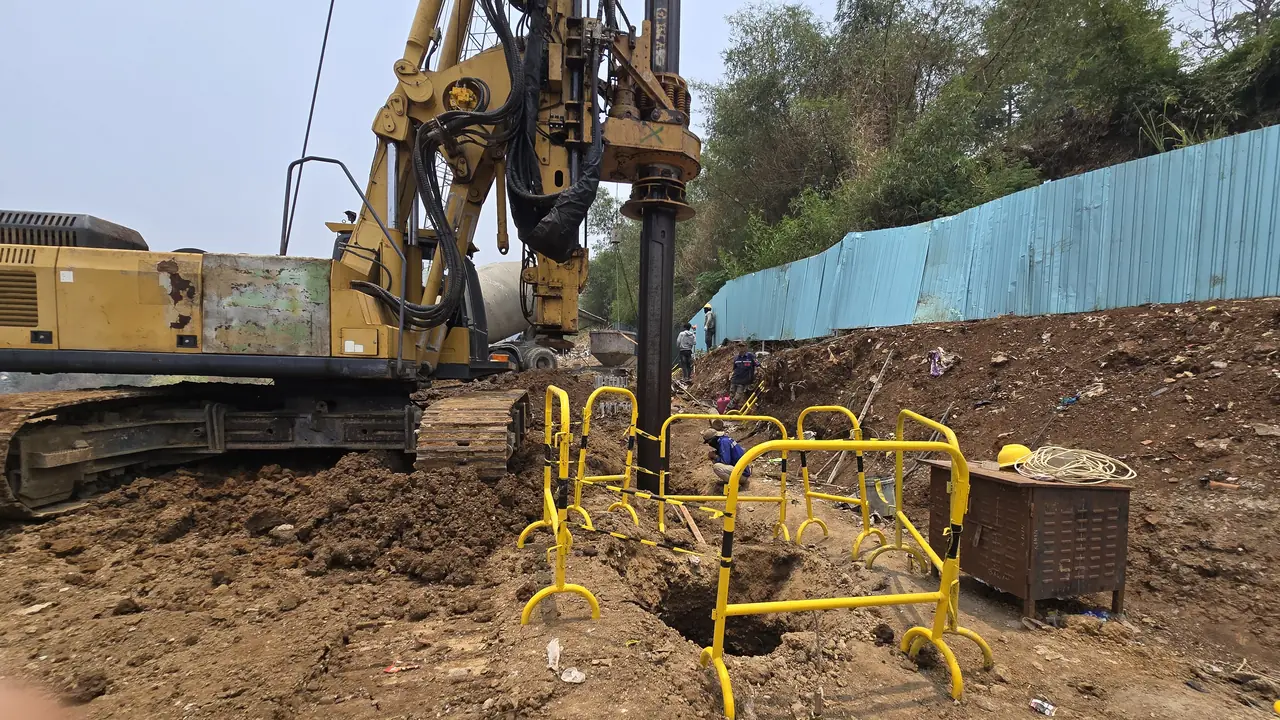
Method of Work
Sequence of executionPile positions follow the shop drawings, and verticality is maintained throughout drilling. Deviation at this stage cannot be corrected once concrete is in.
The drilling method is matched to soil conditions. Casing is used in collapse-prone ground so the bore wall holds until concreting.
The base of the bore is cleaned before the cage is lowered. Bar configuration follows the design drawings and is recorded pile by pile.
Concreting proceeds once the bore is ready. Ground surface, bore length, effective length, tip level and stop-cast are recorded for every pile.
Testing & Reporting
Quality evidence per pileThere is no uniform testing package, because every project differs. What owners request most often is PDA and PIT testing, and we prepare it to each project’s specification. Beyond testing, every pile carries its own piling record covering ground surface, bore length, effective length, tip level, stop-cast, bar configuration, and soil data from samples taken during drilling — so ground conditions at each point are documented, not assumed from the nearest CPT.
Drilling Methods
Matched to site conditionsMost design consultants already understand bored piling, so the questions that reach us go straight to execution: can the work be done using dry bore, or does it need wash boring. We do both, and the choice depends on the soil and the groundwater table on site.
Service Area
Greater Jakarta and beyond JavaWe are based in Bekasi Regency and work from Greater Jakarta through to islands beyond Java. Completed projects run from Jakarta, Serpong and Cikande to Kota Baru Parahyangan, Bandung, Semarang and Manado. For sites outside daily reach, mobilisation and crew accommodation are priced separately and stated openly in the quotation. For work inside the city, the conditions and constraints are set out separately on the bored pile Jakarta page.
How We Work Together
From first question to mobilisationCone penetration or boring logs, foundation drawings, a site layout and your target schedule. The more complete the data, the fewer assumptions have to be priced in.
Our engineering team checks the method, diameter and depth. If something in the data looks odd, we raise it first — rather than letting it surface on site.
The quotation states the scope plainly: whether concrete and steel are included, who carries the testing, and what is excluded.
Once the scope is agreed, plant and crew mobilise. Requirements for working area, access road, water and power are stated before anything leaves the yard.
Every pile is recorded the same day. Daily reports and piling records are handed over as work proceeds, not stacked up at the end.
What You Receive
More than piles in the groundWhat separates accountable work is the paperwork behind it. On our most recent project in Manado, all 75 piles were documented one by one: a work permit before drilling, a piling record per pile, a summary table, resurveyed as-built coordinates, daily reports, and photographs of every stage at every point. All of it is handed to the owner as one file.
Questions and Answers
The ones we are asked mostWhat pile diameters do you drill?
From Ø 400 to Ø 1,000 mm with our own equipment, and up to Ø 1,200 mm with a change of rig. The diameter follows the design load and the ground. In practice, going wider is sometimes cheaper than adding piles, because mobilisation and the time spent per pile barely change.
How long does one pile take?
It depends on the ground. In clay a pile can be finished in hours. In boulder-filled ground such as our Manado project, a single pile can take more than sixteen hours because the toe must be cut into rock. Schedules are therefore built from soil data, not from pile counts alone.
What do you need before quoting?
Cone penetration or boring logs, foundation drawings, a site layout and your target schedule. If the data is incomplete, send what you have — it is usually enough to settle the method.
How soon does a quotation arrive?
Usually about one working week after the site survey. The sequence is: your data and drawings come in, we schedule a survey to check access and site conditions, then the quotation is prepared. We can give a first estimate before the survey, but a firm figure only follows once we have seen the site.
Can you work on a tight site?
Yes, as long as the rig can get in and has room to work. Most of our projects are on constrained sites — MD Residence in Semarang sits on a stepped plot hemmed in by retaining walls and neighbouring houses, and Emerald Hill 45 in Dago was built on a slope inside an excavation already held by a retaining wall. What we need is access for the rig and the mixer truck, plus working space around each pile. Send photos or a plan of the access and we will assess it before the survey.
Will the work disturb neighbouring buildings?
Bored piles are drilled rather than driven, so the work is practically free of vibration. That is why the method is chosen in dense neighbourhoods and on sites that keep operating — as at the Indah Kiat mill in Serpong, where the warehouse, pump room and pipe racks stayed in use throughout the works.
How is pile quality proven?
Through the piling record for each pile and through testing: PIT for the integrity of the shaft, PDA for bearing capacity. How many piles are tested is set by the consultant or the project specification.
Is there a minimum job size?
There is no minimum number of piles. What applies is a minimum charge equivalent to 1,000 linear metres of drilling, because mobilising the rig and the crew costs much the same whether the job is small or large. We still take work below that — several of our projects are private houses.
Does the price include materials?
Two models are common: labour and plant only, with concrete and reinforcement supplied by the owner or main contractor, or a full scope including materials. We work with both, and our quotation always states which one applies.
Our Bored Piling Projects
Field track record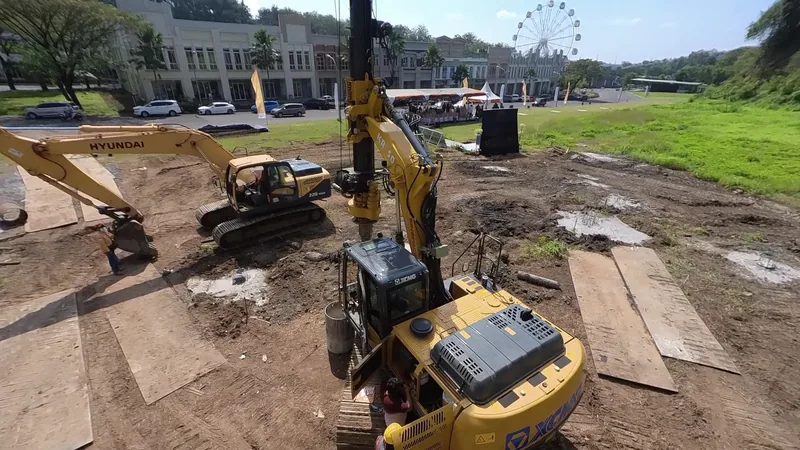
Discuss your requirements
Not sure which foundation method suits your site? Just describe the conditions — our engineering team is glad to help, with no obligation.
WhatsApp: +62 811-902-590 Download Company Profile PDF · 3 MBSaturday 10:00–12:00 WIB
Closed on Sundays and public holidays